





Donor retention and acquisition continue to define the fundraising landscape in 2026, shaping how organizations plan, invest, and grow.
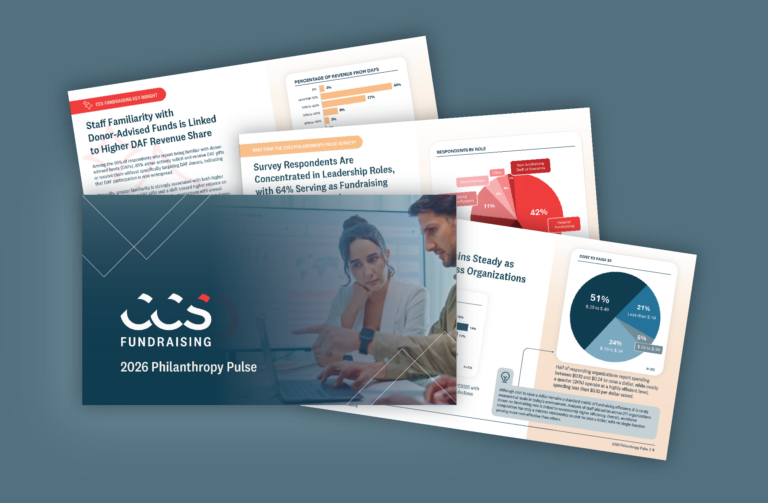
Of more than 600 organizations contributing insights to CCS’s 2026 Philanthropy Pulse report, 68% of nonprofits cited acquisition as a leading challenge, with 48% pointing to retention.
Steps For Developing a Successful Acquisition and Retention Plan
Building a donor acquisition and retention strategy requires more than tactics. It calls for aligning your broader fundraising strategy with donor engagement and long-term relationship building. By taking a structured approach, you can align resources, messaging and goals to drive both immediate and sustained results.
Consider the following steps to guide your strategy:
- Examine the trends
- Assess your organization’s data and trends
- Segment your audiences
- Develop compelling content
- Set measurable goals
- Strategically budget for success
- Keep it simple
1. Examine the trends for donor retention and acquisition.
Episodic Donors
In 2026, organizations are again re-evaluating their donor acquisition and retention strategies to sustain support beyond short-term spikes in engagement. This includes demonstrating the lasting impact and relevance of their missions, even as immediate pressures subside.
In 2024, many organizations grappled with engaging election-year donors, supporters whose contributions were driven by heightened attention to mission-driven causes during the election cycle.
This builds on a shift that began in 2020 as organizations worked to convert “crisis donors” into “mission donors” committed to long-term support. Sustained success depends on creating consistent engagement that keep donors connected to your mission over time.
Generational Donor Acquisition and Retention Trends
Of course, episodic giving is only one way to understand donor behavior in 2026. Alongside these patterns, demographic insights offer another lens for understanding how generational cohorts engage, providing valuable direction for segmentation, messaging, and engagement strategies.
While no single dataset captures population, wealth, and giving behavior across all generations within a single year, taken together, leading sources provide a reliable view of current patterns. These include the U.S. Census Bureau cohort data (2025),1 the Federal Reserve Distributional Financial Accounts (2026),2 Giving USA Generations and Giving (2025),3 and the Bank of America Study of Philanthropy (2025).4
- The Silent Generation (born 1925 to 1945) comprises approximately 4.9% of the U.S. population1 and holds an estimated $20.8 trillion in assets.2 Despite representing a smaller share of the population, this group continues to play a significant role in philanthropy due to its concentration of wealth. Donors in this cohort consistently demonstrate strong loyalty, long-term commitment, and relationship-based giving. They are highly responsive to trust, institutional credibility, and personal connection, making them a cornerstone of major gifts, planned giving, and long-term stewardship strategies.
- Baby Boomers (born 1946 to 1964) represent roughly 20% of the U.S. population1 and hold the largest share of household wealth, estimated at approximately $88.5 trillion.2 This concentration reinforces their central role in both annual giving and major gift activity. They remain central to charitable giving and are particularly responsive to established institutions, demonstrated impact, and established relationships.3,4
- Generation X (born 1965 to 1980) comprises approximately 19.5% of the population1 and holds an estimated $45.4 trillion in assets.2 As a cohort in peak earning years, Gen X plays a critical role in philanthropy. These donors prioritize efficiency, transparency, and measurable impact, and are highly engaged across channels.3,4
- Millennials (born 1981 to 1996) make up approximately 21.7% of the population1 and hold an estimated $18.3 trillion in assets.4 Their influence continues to grow as they advance in their careers and expand their financial capacity. Millennial donors are guided by values, alignment, and authenticity. They expect transparency and clear communication of impact and are more likely to research organizations before giving.3,4
- Generation Z (born 1997 to 2012) represents approximately 20.7% of the population1 and is emerging as a critical future donor segment. While their financial capacity is still developing, their influence is already shaping how organizations engage supporters. These donors prioritize authenticity, transparency, and visible impact, often engaging through digital platforms, peer networks, and advocacy-based participation.3,4 Building trust with this generation now is essential for long-term sustainability.
These generational shifts, combined with the rise of episodic giving, reflect a distinct moment in today’s philanthropic landscape. They present a clear opportunity to reassess how organizations approach donor retention and acquisition.
As competition for attention and dollars intensifies, nonprofits continue to face challenges in building and sustaining their donor base. Having examined the broader external trends shaping donor behavior, the next step is to turn inward.
2. Assess your organization’s data and trends.
The past five years have seen industry-wide philanthropic trends shift at an accelerated pace. It is likely that your organization has also experienced notable changes in how donors engage. A key step in developing a strong acquisition and retention strategy is understanding your organization’s own data and how it has evolved over time.
As you take a deeper look at your donor retention and acquisition rates, consider the following questions:
- How successful were your donor retention and acquisition efforts in years past?
- How have economic, political, and funding changes influenced this trajectory?
- Which donor segments experienced the most fluctuation?
- Which communication channels have been most effective in reaching your audience?
As organizations deepen their analysis of donor behavior, advanced analytics and predictive tools can help translate those insights into more effective engagement strategies across channels.

Leveraging AI and Data
Predictive AI can support both acquisition and retention by identifying patterns in donor behavior, including giving history, demographics, and engagement levels. These tools enable organizations to prioritize high-potential donors, allocate resources more effectively, and improve return on investment.
Advanced analytics are increasingly essential. Organizations that apply data rigorously are better positioned to improve targeting, increase efficiency, and drive stronger fundraising outcomes.
Direct Marketing and Channel Mix
Some organizations, citing success in digital fundraising and an increased focus on sustainable practices, have drastically reduced or eliminated direct mail outreach. Others are finding even greater success through acquisition mailings. Now is the time to deeply assess what your data tells you about the direction your organization might be heading.
These questions will be important to explore to get a clearer picture of how your organization has experienced the uncertainty of the past few years. Once you uncover trends in your organization’s fundraising data, you can begin to develop and implement a plan to capitalize on the areas where you’ve been successful.
3. Segment your audience.
Now that you’ve taken a magnifying glass to your organization’s recent data and trends, it’s time to put a plan into action. The outcomes of your internal assessment should provide a good starting point for formulating your acquisition and retention plan for 2026.
A good acquisition and retention plan should speak directly to your target audiences through compelling storytelling, clear and measurable goals, and a donor-centric experience that is simple and intuitive to engage with. It should also be flexible enough to adapt as donor behavior and performance data evolve.
Segmentation remains foundational to effective fundraising, but donor expectations have evolved. Engagement needs to be personalized, timely, and reflective of how different audiences choose to give. Effective segmentation recognizes differences in demographics, wealth, behavior, and engagement preferences, translating those differences into tailored messaging and clearly defined donor journeys. For example, a first-time $20 gift made through social media may require a different engagement approach than a similar gift made by mail.
Strategies should reflect these differences through tailored messaging and clearly defined donor journeys.
A strong acquisition and retention plan is structured, measurable, and centered on creating meaningful donor experiences.
4. Create timely, compelling, and personalized content.
Content is the primary way donors experience and understand your mission. It must clearly communicate impact, relevance, and urgency.
Successful strategies focus on storytelling that shows how and why your mission matters now. Organizations that communicate impact effectively build stronger trust and sustain deeper relationships.
What stories can your organization tell that demonstrate impact as it is happening today?
Content should also reflect an increasingly diverse donor base and support a more inclusive and equitable philanthropic field. It serves as the primary entry point for donor engagement, making it essential to create targeted and meaningful journeys that help donors understand why their support matters and why it matters at this moment.
5. Set measurable goals and continuously adapt.
Clear, measurable goals are essential. Define specific targets for both donor acquisition and retention, and establish a regular cadence for evaluating progress against those benchmarks. Organizations that consistently measure performance are better positioned to adjust priorities and strategies as donor behavior evolves. Donor retention remains a persistent challenge across the industry, with industry-wide rates below 50%.5 CCS’s internal Data Analytics team observes an average donor retention rate of 46% across the organizations CCS has worked with over the last five years.
These benchmarks can help inform realistic goal-setting and highlight where focused effort is needed to improve long-term donor engagement. Regularly tracking performance and adjusting in response ensures your strategy remains aligned with both organizational goals and changing donor behavior.
6. Align budget with acquisition and retention priorities.
As acquisition becomes more competitive and retention remains variable, organizations must align resources with strategic priorities.
High-net-worth donors continue to account for a significant share of total giving,4 reinforcing the importance of targeted acquisition and long-term stewardship strategies.
If donor growth has been driven in part by organic acquisition in recent years, the effective cost of acquiring those donors may be lower than in traditional acquisition efforts. This creates an opportunity to shift greater investment toward retention and long-term donor engagement.
Budget decisions should be tied to measurable outcomes and focused on maximizing both short-term performance and long-term donor value.
7. Make giving seamless across all touchpoints.
Ease of giving is a critical driver of both conversion and retention. Donors expect a seamless, intuitive experience across all platforms.
Even highly engaged donors may abandon a gift if the process is complicated or time-consuming. Reducing friction and simplifying the experience can significantly improve both initial conversion and repeat giving.
This could include streamlining donation pathways, reducing unnecessary steps, and ensuring a consistent experience across digital and offline channels.
Even small improvements in the donor experience can meaningfully increase conversion rates and long-term retention.
Bringing Your Donor Retention and Acquisition Strategy Together
Donor behavior continues to evolve, and competition for attention remains high. Organizations must take a disciplined, data-informed, and adaptable approach.
By combining advanced analytics, precise segmentation, compelling content, and seamless donor experiences, nonprofits can build resilient strategies that attract new supporters and strengthen long-term engagement.
With a clear plan and thoughtful execution, organizations can expand their donor base, deepen relationships, and achieve lasting impact.
References
1 U.S. Census Bureau. Birth Cohort Geographic Mobility in the United States: 2005–2023. https://www.census.gov/library/publications/2025/acs/acs-60.html
2 Federal Reserve. Distributional Financial Accounts of the United States. https://www.federalreserve.gov/releases/z1/dataviz/dfa/distribute/chart/
3 Giving USA Foundation. Giving USA 2025. https://givingusa.org/product/giving-usa-2025-the-annual-report-on-philanthropy-for-the-year-2024/
4 Indiana University Lilly Family School of Philanthropy & Bank of America. 2025 Study of Philanthropy. https://scholarworks.iupui.edu/handle/1805/41796
5 Association of Fundraising Professionals. Fundraising Effectiveness Project. https://afpglobal.org/FundraisingEffectivenessProject
This article was originally published on February 11, 2025
More Insights
2026 Philanthropic Landscape, 15th Edition
This report provides a comprehensive look at the current state of U.S. philanthropy, compiling and analyzing annual data from Giving USA and other prominent research…

Excel Dashboards That Support Better Fundraising Decisions
Learn how fundraising Excel dashboards can help nonprofit teams organize data, improve reporting, and make more informed fundraising.

How a $60 Million Gift Is Powering Sarasota Orchestra Music Center’s Legacy for Music and Community